


intraclass computes interrater-reliability intraclass correlation coefficients (ICCs). An ICC is the share of the variation in scores that reflects real differences between the things rated, rather than rater noise. It works within the generalizability-theory framework, using modern variance-component estimation (linear mixed models) rather than the classical ANOVA / mean-squares approach.
It aims to fit variance components, each a share of the total variation traced to one source. It uses modern engines, an engine being the software that does the fitting. It aims to compute the correct ICC for a stated design. It gives a proper Monte-Carlo interval, built by drawing parameter values from the fitted model’s uncertainty. That interval is boundary-aware: an estimate can land exactly at zero, and the interval still behaves. It also aims to handle imbalanced, incomplete, and multilevel designs, and to help you decide which ICC to choose, and why. The docs and website are a place to learn ICC best practice, not only to look up functions.
The full interrater-reliability ICC family is implemented. That
covers two-way designs, where each rater is tracked across the subjects
they score, and one-way designs. Within two-way, it covers absolute
agreement, where raters give the same score, against consistency, where
raters agree apart from a constant offset per rater. It covers
single-rater coefficients, the reliability of one rater’s score, and
average-rater ones, the reliability of a mean of several raters. It
covers random raters against fixed raters, where the observed raters are
the whole population of interest. It covers imbalanced and incomplete
(missing-cell) data. It also covers multilevel designs, where the
subject level is reliability within a cluster, and the cluster level is
reliability of cluster means. In such a design the raters may be crossed
with or nested in clusters or subjects. Everything just listed comes
with boundary-aware Monte-Carlo intervals. Fits run on
glmmTMB (the default) or lme4. Bayesian fits
run on brms, and SEM fits on lavaan. The engines
article says which designs each one supports.
Install the released version from CRAN with:
install.packages("intraclass")Or install the development version from GitHub with:
# install.packages("pak")
pak::pak("jmgirard/intraclass")
intraclass declares cli, generics,
glmmTMB, lifecycle, rlang, and
tibble as its non-base Imports:. What an
installation retrieves is the full dependency closure of those
declarations, which is considerably larger. One member of that closure
is worth naming. glmmTMB lists lme4 in its own
Imports:. So the lme4 package is already on
your library path after a plain install, whatever its
Suggests: placement here implies. Having the package is not
the same as having the engine, though. engine = "lme4" also
needs merDeriv, which every lme4 fit checks for on entry
whatever interval method you ask for. merDeriv does not
arrive. It sits in this package’s Suggests:, and so do
brms, the Bayesian engine, and lavaan, the SEM
engine. A plain install fetches none of the three. Asking for
merDeriv does bring lavaan along, though,
because merDeriv names it in its own Depends:.
glmmTMB is the only engine a plain install leaves you ready
to use.
ratings is the classic Shrout & Fleiss (1979)
example, shipped with the package. With the defaults a single two-way
random fit reports every defined formulation: absolute agreement and
consistency, single-rater and average. They are grouped by error
definition, each with a reproducible Monte-Carlo interval:
library(intraclass)

fit <- icc(ratings, score, subject, rater, seed = 2024)
fit
#> ── Intraclass correlation: two-way random, absolute agreement & consistency ────
#> Subjects: 6 | Raters: 4 (random) | Observations: 24 of 24 cells (complete)
#> Engine: glmmTMB (REML) | CI: 95% montecarlo (10000 draws)
#>
#>   index     estimate   95% CI
#>   Absolute agreement
#>   ICC(A,1)     0.290   [0.050, 0.717]
#>   ICC(A,k)     0.620   [0.173, 0.910]
#>   Consistency
#>   ICC(C,1)     0.715   [0.341, 0.926]
#>   ICC(C,k)     0.909   [0.674, 0.980]
#>
#> Variance components: subject 2.556, rater 5.244, residual 1.019
#> Shrout & Fleiss equivalent: ICC(A,1) = ICC(2,1), ICC(A,k) = ICC(2,k)
autoplot() draws the same fit as a forest plot (it needs
ggplot2):
library(ggplot2)

autoplot(fit)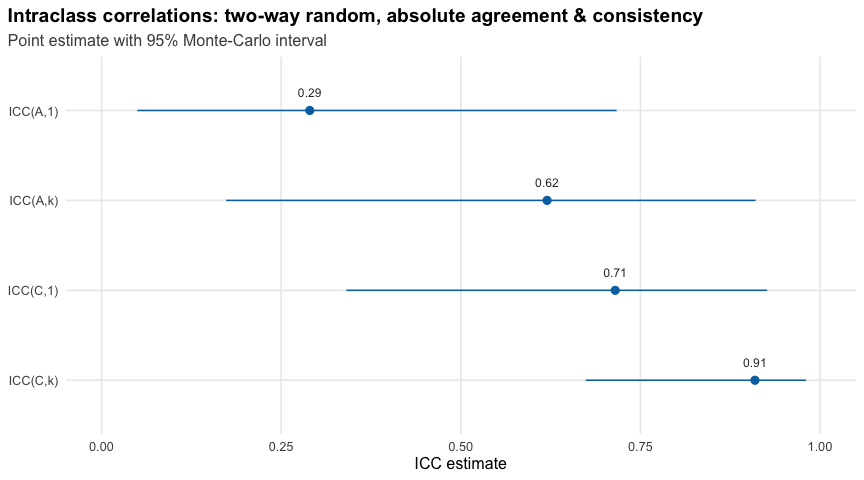
Which coefficient you want is a real modeling decision: agreement vs.
consistency, single vs. average, fixed vs. random raters, complete vs.
incomplete. Each of those is an argument to icc(). Not sure
which to report? choose_icc() walks the Choosing
an ICC decision tree. It hands back the coefficient or
coefficients, the reasoning, and the exact call to run. No data or
fitting is required:
choose_icc(model = "twoway", type = "consistency", unit = "average", raters = "random")
#> ── Recommended ICC ─────────────────────────────────────────────────────────────
#> Design: two-way random, consistency
#>
#> Recommendation: ICC(C,k)
#>
#> Why:
#>   - Crossed (two-way): each rater is tracked across the subjects they score.
#>   - Consistency: only the rank order must match. A constant per-rater offset is forgiven.
#>   - Average: you will act on the mean of your raters.
#>   - Random raters: a sample you generalize beyond, to the rater universe they were drawn from.
#>
#> Run this on your data:
#>   icc(data, score, subject, rater, type = "consistency", unit = "average")
#>
#> Notes:
#>   - Complete vs. incomplete is automatic: icc() uses whatever ratings are present and projects ICC(*,k) to the effective number of ratings (k_eff). The design must stay connected, or icc() fails loudly.
For multilevel data, meaning subjects nested in
clusters such as pupils in classrooms or patients in clinics, pass a
cluster column. Then icc() reports
subject-level and cluster-level reliability separately. The shipped
school data are a simulated example, pupils nested in
classrooms:
icc(school, score, subject = pupil, rater = rater, cluster = classroom, seed = 2024)
#> ℹ Treating raters with the same label in different clusters as the same raters
#>   (crossed with clusters, Design 1).
#> ℹ If each cluster has its own raters, give them cluster-unique labels or pass
#>   `design = "nested_in_clusters"`.
#> ── Intraclass correlation: multilevel two-way random, absolute agreement & consi
#> Subjects: 80 in 16 clusters | Raters: 4 (random) | Observations: 320 (complete)
#> Engine: glmmTMB (REML) | CI: 95% montecarlo (10000 draws)
#>
#>   level      index     estimate   95% CI
#>   Absolute agreement
#>   subject    ICC(A,1)     0.431   [0.258, 0.562]
#>   subject    ICC(A,k)     0.751   [0.582, 0.837]
#>   cluster    ICC(A,1)     0.880   [0.000, 0.974]
#>   cluster    ICC(A,k)     0.967   [0.000, 0.993]
#>   Consistency
#>   subject    ICC(C,1)     0.493   [0.373, 0.616]
#>   subject    ICC(C,k)     0.796   [0.704, 0.865]
#>   cluster    ICC(C,1)     1.000   [0.000, 1.000]
#>   cluster    ICC(C,k)     1.000   [0.000, 1.000]
#>
#> Variance components: cluster 0.998, subject 0.461, rater 0.136, cluster:rater 0.000, residual 0.473
#>
#> This message is displayed once per session.
The cluster-level consistency rows sit on a boundary here: the
classroom-by-rater variance is estimated at zero, so
ICC(C,1) reaches 1 and its interval spans the whole range.
The multilevel article (vignette("multilevel-designs"))
explains what each level measures.
d_study() runs a D-study, which projects the fitted
variance components to other rater or occasion
counts, carrying the interval with them. So you can ask what reliability
two raters would buy, or ten, without running the study again:
autoplot(d_study(fit, m = 1:10))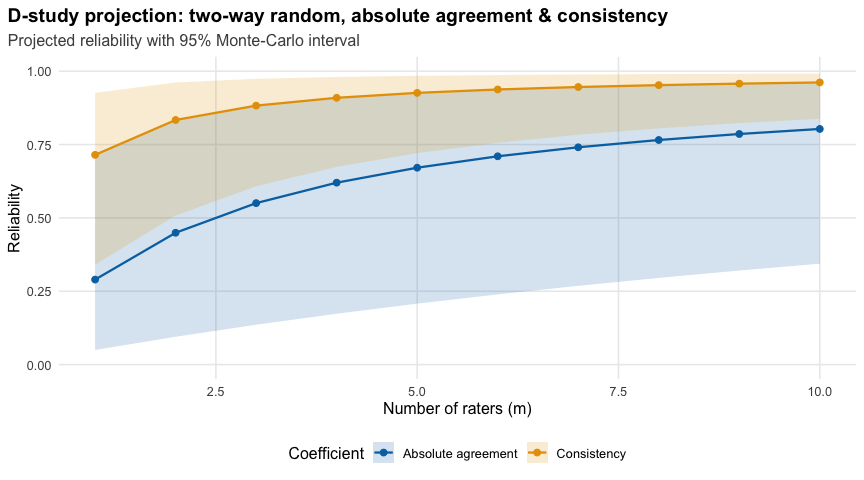
choose_icc().ci_method menu.citation("intraclass")
#> To cite intraclass in publications use:
#>
#> Girard J (2026). _intraclass: Modern Intraclass Correlation
#> Coefficients_. R package version 0.2.0,
#> <https://CRAN.R-project.org/package=intraclass>.
#>
#> A BibTeX entry for LaTeX users is
#>
#> @Manual{intraclass,
#> title = {{intraclass}: Modern Intraclass Correlation Coefficients},
#> author = {Jeffrey Girard},
#> year = {2026},
#> note = {R package version 0.2.0},
#> url = {https://CRAN.R-project.org/package=intraclass},
#> }
#>
#> A companion software paper will be drafted at
#> https://github.com/jmgirard/intraclass-paper.The companion software paper will be drafted in its own repository.
Bug reports and questions are welcome on the issue tracker. The contributing guide says what to include, and why code contributions are not solicited.
| Approach | Packages | What you get |
|---|---|---|
| Classical ANOVA / mean squares | psych, irr, irrNA,
irrICC, ICCDesign |
ANOVA / mean-squares based, mostly assuming balanced data |
| Model-based variance partition | performance::icc, misty |
A variance-partition coefficient, but not the full interrater-reliability ICC family, the error-variance framing, or a selection framework |
| intraclass | (this package) | Mixed-model estimation, Monte-Carlo confidence intervals, and decision guidance |
intraclass fills that gap, following ten Hove, Jorgensen & van der Ark.