





spicy is an R package for publication-ready tables: frequency tables and cross-tabulations, association measures, categorical and continuous summary tables, regression tables for 30+ model classes, and labelled survey data workflows.
Every spicy table prints as readable text in the console and exports to gt, tinytable, flextable, Excel, Word, or the clipboard, following rigorous reporting conventions – APA by default, with named journal styles. Around the tables, spicy provides the survey-data tools that feed them: variable inspection, codebooks, label extraction, and row-wise summaries.
freq().cross_tab():
percentages, weights, chi-squared tests, and effect sizes.cramer_v(),
phi(), gamma_gk(),
kendall_tau_b(), somers_d() and 6 other
coefficients; assoc_measures() computes the full set at
once.table_categorical() and table_continuous(),
overall or by group.table_outcome(): one continuous outcome described across
several groupings, one block of rows per grouping variable, a group
comparison per block, and a marginal Overall row – the
transpose of table_continuous(), with the same statistic
vocabulary and output engines.table_continuous_svy() and
table_categorical_svy() on a survey::svydesign
object: estimates, SEs and CIs from the survey package
(Taylor linearization or replicate weights), design degrees of freedom,
observed and weighted counts – the design twins of the two families
above, with the same statistic vocabulary and output engines.table_continuous_lm() for linear-model reporting: classical
/ HC* / cluster-robust / bootstrap / jackknife variance, four
effect-size families (f², Cohen’s d, Hedges’ g, Hays’ omega²) with
noncentral CIs, additive covariate adjustment with G-computation (Stata
margins style) or equal-weight (emmeans style)
marginal means, and weighted comparisons.table_regression() for one or more fitted models side by
side, across 30+ model classes (see Supported models below):
classical / heteroskedasticity-robust / cluster-robust / bootstrap /
jackknife variance with each class’s field-standard backend,
standardized coefficients, family-aware exponentiate (OR /
IRR / HR / RR / MR, link-gated), Wald or profile-likelihood CIs, average
marginal effects (per-category for ordinal and multinomial models),
partial f² / η² / ω² / χ² effect
sizes, class-aware fit statistics (pseudo-R², Nakagawa marginal
/ conditional R², ICC), hierarchical model comparisons with the
correct nested test per class, and multiple-comparison adjustment. Mixed
models report their random effects as table rows with an optional
boundary-correct per-term test; ordinal models report their thresholds;
zero-inflated and hurdle models report every model component. Survival
models go beyond hazard ratios: adjusted restricted-mean-survival-time
and risk differences by g-computation (tau /
at_time), for coxph fits (stratified included)
and survreg AFT fits, in single tables and in the
univariable screen.table_regression_uv(): one-predictor-at-a-time models
merged with the multivariable fit, per-predictor N and events, for
glm, lm, and Cox outcomes.spicy_style():
style = "jama", "nejm", "lancet",
"annals", "apa", or "aer"
restyles any table, every rule sourced from each style’s published
guidelines. For a French table,
options(spicy.language = "fr") gives the words and the
French typography together.varlist() and
vl(): names, labels, values, classes, distinct values
(N_distinct), valid observations (N_valid),
and missing data.code_book():
interactive and exportable, for labelled and survey-style datasets.label_from_names(), including LimeSurvey-style
headers.mean_n(),
sum_n(), and count_n(), with explicit control
over missing values.Works with labelled, factor,
ordered, Date, POSIXct, and other
common variable types – and honors declared missing
values (haven’s na_values/na_range,
tagged NAs) across the descriptive functions, with disclosure notes and
a user_na escape hatch. For a full introduction, see Getting
started with spicy.
events/N counts, reference
rows, block structure, captions, and disclosure notes included. What you
publish is what you saw.survival::concordance(), exact order-statistic confidence
intervals for medians), and each convention is documented where the
number is produced.as_structured() returns the complete typed view of a
regression table – values, precisions, significance markers, row roles –
with an explicit contract version, so custom renderers and downstream
pipelines can detect changes instead of silently mis-reading them.table_regression() accepts a single fit or a list of
fits from any of these classes, and renders them with the conventions of
each model family:
| Family | Engines |
|---|---|
| Linear and generalized linear | stats::lm(), stats::glm(),
MASS::glm.nb(), MASS::rlm(),
stats::nls() |
| Robust, IV, quantile, panel | estimatr::lm_robust(),
estimatr::iv_robust(), AER::ivreg(),
AER::tobit(), quantreg::rq(),
fixest::feols(), fixest::feglm(),
fixest::fepois(), fixest::fenegbin() |
| Mixed effects | lme4::lmer(), lme4::glmer(),
glmmTMB::glmmTMB(), nlme::lme(),
nlme::gls() |
| Ordinal and categorical | MASS::polr(), ordinal::clm()
(incl. partial proportional odds), nnet::multinom(),
mlogit::mlogit() |
| Counts, two-part models | pscl::hurdle(), pscl::zeroinfl(),
glmmTMB::glmmTMB() (zero-inflation and dispersion
components) |
| Survival | survival::coxph(), survival::survreg(),
rms::cph(), flexsurv::flexsurvreg() |
| Survey-weighted | survey::svyglm() (design-based SEs) |
| Population-averaged (GEE) | geepack::geeglm() (native sandwich SEs, working
correlation disclosed) |
| Additive, proportions, selection | mgcv::gam(), mgcv::bam(),
betareg::betareg(),
sampleSelection::selection() |
| rms | rms::ols(), rms::lrm(),
rms::Glm() |
| Bayesian | rstanarm::stan_glm(),
rstanarm::stan_glmer(), brms::brm() (posterior
median, credible intervals, no p-values) |
Class-specific structure renders as labelled blocks in the same table: random effects (with SE and CI on each variance component, and an optional boundary-correct per-term likelihood-ratio test), ordinal thresholds, non-proportional effects, zero-inflation and dispersion components. Robust variance requests use each class’s field-standard backend and are refused with a clear message when no valid backend exists.
The full capability map – each family’s marginal-effects estimand,
exponentiate semantics, robust-variance backends and
standardized-coefficient support – is the Supported
models article; table_regression_models() returns the
same registry as a data frame.
Install the current CRAN release, recommended for most users:
install.packages("spicy")Install the latest r-universe build:
install.packages(
  "spicy",
  repos = c(
    "https://amaltawfik.r-universe.dev",
    "https://cloud.r-project.org"
  )
)
This installs spicy from r-universe when available; CRAN
is included only as a fallback for dependencies. The r-universe build
may be newer than the current CRAN release.
Install the development version from GitHub with
pak:
# install.packages("pak")
pak::pak("amaltawfik/spicy")
Or with remotes:
# install.packages("remotes")
remotes::install_github("amaltawfik/spicy")The examples below use the bundled sochealth
dataset.
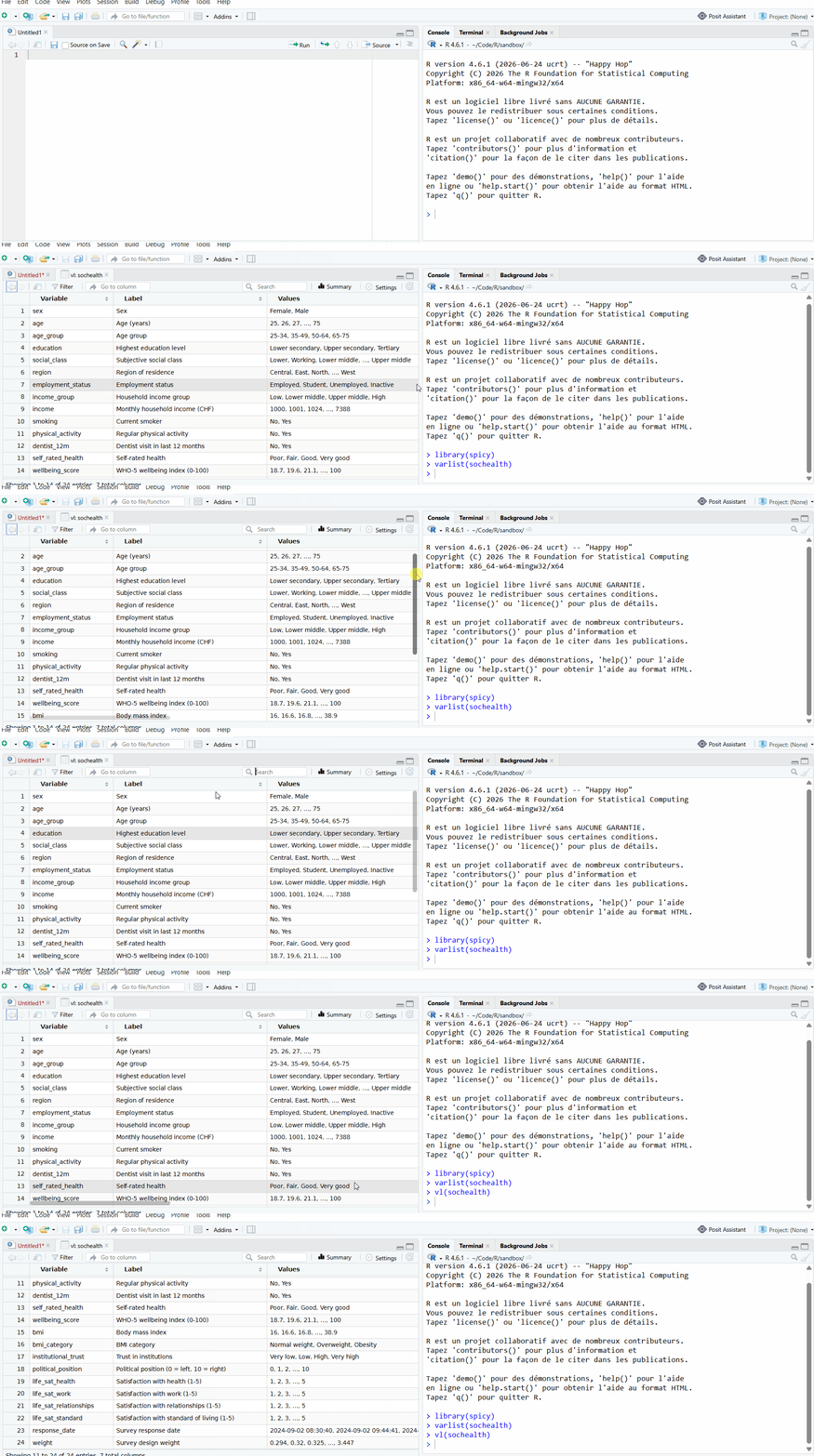
varlist(sochealth, tbl = TRUE)
#> # A tibble: 24 × 7
#>    Variable          Label                 Values Class N_distinct N_valid   NAs
#>    <chr>             <chr>                 <chr>  <chr>      <int>   <int> <int>
#>  1 sex               Sex                   Femal… fact…          2    1200     0
#>  2 age               Age (years)           25, 2… nume…         51    1200     0
#>  3 age_group         Age group             25-34… orde…          4    1200     0
#>  4 education         Highest education le… Lower… orde…          3    1200     0
#>  5 social_class      Subjective social cl… Lower… orde…          5    1200     0
#>  6 region            Region of residence   Centr… fact…          6    1200     0
#>  7 employment_status Employment status     Emplo… fact…          4    1200     0
#>  8 income_group      Household income gro… Low, … orde…          4    1182    18
#>  9 income            Monthly household in… 1000,… nume…       1052    1200     0
#> 10 smoking           Current smoker        No, Y… fact…          2    1175    25
#> # ℹ 14 more rowscode_book(
sochealth,
starts_with("bmi"),
values = TRUE,
include_na = TRUE
)See Explore
variables and build codebooks for more on varlist(),
vl(), and code_book().
freq(sochealth, income_group)
#> Frequency table: income_group
#>
#>  Category   │ Values            Freq.    Percent    Valid Percent
#> ────────────┼─────────────────────────────────────────────────────
#>  Valid      │ Low                 247       20.6             20.9
#>             │ Lower middle        388       32.3             32.8
#>             │ Upper middle        328       27.3             27.7
#>             │ High                219       18.2             18.5
#>  Missing    │ NA                   18        1.5
#> ────────────┼─────────────────────────────────────────────────────
#>  Total      │                    1200      100.0            100.0
#>
#> Label: Household income group
#> Class: ordered, factor
#> Data: sochealth

cross_tab(sochealth, smoking, education, percent = "col")
#> Crosstable: smoking x education (Column %)
#>
#>  Values   │   Lower secondary    Upper secondary    Tertiary │   Total
#> ──────────┼──────────────────────────────────────────────────┼─────────
#>  No       │              69.6               78.7        84.9 │    78.8
#>  Yes      │              30.4               21.3        15.1 │    21.2
#> ──────────┼──────────────────────────────────────────────────┼─────────
#>  Total    │             100.0              100.0       100.0 │   100.0
#>  N        │               257                527         391 │    1175
#>
#> Chi-2(2) = 21.6, p <.001
#> Cramer's V = 0.14
#> Missing values removed: smoking (25).
See Frequency
tables and cross-tabulations for freq(),
cross_tab(), percentages, weights, and tests.
tbl <- xtabs(~ self_rated_health + education, data = sochealth)

# Quick scalar estimate
cramer_v(tbl)
#> [1] 0.1761697

# Detailed result with CI and p-value
cramer_v(tbl, detail = TRUE)
#> Estimate  SE  CI lower  CI upper      p
#>    0.176   –     0.120     0.231  <.001
See Cramer’s V, Phi, and association measures for a guide on choosing the right measure.
table_categorical(
  sochealth,
  select = c(smoking, physical_activity),
  labels = c(
    smoking           = "Current smoker",
    physical_activity = "Physical activity"
  )
)
#> Categorical table
#>
#>  Variable            │   n      %
#> ─────────────────────┼───────────────
#>  Current smoker      │
#>    No                │  926    77.2
#>    Yes               │  249    20.8
#>    (Missing)         │   25     2.1
#> ╌╌╌╌╌╌╌╌╌╌╌╌╌╌╌╌╌╌╌╌╌┼╌╌╌╌╌╌╌╌╌╌╌╌╌╌╌
#>  Physical activity   │
#>    No                │  650    54.2
#> Yes │ 550 45.8table_categorical(
sochealth,
select = c(smoking, physical_activity),
by = education,
labels = c(
smoking = "Current smoker",
physical_activity = "Physical activity"
)
)
#> Categorical table by education
#>
#> Variable │ Lower secondary n Lower secondary % Upper secondary n
#> ───────────────────┼─────────────────────────────────────────────────────────
#> Current smoker │
#> No │ 179 68.6 415
#> Yes │ 78 29.9 112
#> (Missing) │ 4 1.5 12
#> ╌╌╌╌╌╌╌╌╌╌╌╌╌╌╌╌╌╌╌┼╌╌╌╌╌╌╌╌╌╌╌╌╌╌╌╌╌╌╌╌╌╌╌╌╌╌╌╌╌╌╌╌╌╌╌╌╌╌╌╌╌╌╌╌╌╌╌╌╌╌╌╌╌╌╌╌╌
#> Physical activity │
#> No │ 177 67.8 310
#> Yes │ 84 32.2 229
#>
#> Variable │ Upper secondary % Tertiary n Tertiary % Total n
#> ───────────────────┼────────────────────────────────────────────────────
#> Current smoker │
#> No │ 77.0 332 83.0 926
#> Yes │ 20.8 59 14.8 249
#> (Missing) │ 2.2 9 2.2 25
#> ╌╌╌╌╌╌╌╌╌╌╌╌╌╌╌╌╌╌╌┼╌╌╌╌╌╌╌╌╌╌╌╌╌╌╌╌╌╌╌╌╌╌╌╌╌╌╌╌╌╌╌╌╌╌╌╌╌╌╌╌╌╌╌╌╌╌╌╌╌╌╌╌
#> Physical activity │
#> No │ 57.5 163 40.8 650
#> Yes │ 42.5 237 59.2 550
#>
#> Variable │ Total % p Cramer's V
#> ───────────────────┼────────────────────────────
#> Current smoker │ <.001 .14
#> No │ 77.2
#> Yes │ 20.8
#> (Missing) │ 2.1
#> ╌╌╌╌╌╌╌╌╌╌╌╌╌╌╌╌╌╌╌┼╌╌╌╌╌╌╌╌╌╌╌╌╌╌╌╌╌╌╌╌╌╌╌╌╌╌╌╌
#> Physical activity │ <.001 .21
#> No │ 54.2
#> Yes │ 45.8table_continuous(
sochealth,
select = c(bmi, life_sat_health)
)
#> Descriptive statistics
#>
#> Variable │ M SD Min Max 95% CI LL
#> ────────────────────────────────┼──────────────────────────────────────
#> Body mass index │ 25.93 3.72 16.00 38.90 25.72
#> Satisfaction with health (1-5) │ 3.55 1.25 1.00 5.00 3.48
#>
#> Variable │ 95% CI UL n
#> ────────────────────────────────┼─────────────────
#> Body mass index │ 26.14 1188
#> Satisfaction with health (1-5) │ 3.62 1192
#>
#> Missing values removed: bmi (12), life_sat_health (8).table_continuous(
sochealth,
select = c(bmi, life_sat_health),
by = education
)
#> Descriptive statistics by Highest education level
#>
#> Variable │ Group M SD Min Max
#> ────────────────────────────────┼────────────────────────────────────────────
#> Body mass index │ Lower secondary 28.09 3.47 18.20 38.90
#> │ Upper secondary 26.02 3.43 16.00 37.10
#> │ Tertiary 24.39 3.52 16.00 33.00
#> ╌╌╌╌╌╌╌╌╌╌╌╌╌╌╌╌╌╌╌╌╌╌╌╌╌╌╌╌╌╌╌╌┼╌╌╌╌╌╌╌╌╌╌╌╌╌╌╌╌╌╌╌╌╌╌╌╌╌╌╌╌╌╌╌╌╌╌╌╌╌╌╌╌╌╌╌╌
#> Satisfaction with health (1-5) │ Lower secondary 2.71 1.20 1.00 5.00
#> │ Upper secondary 3.53 1.19 1.00 5.00
#> │ Tertiary 4.11 1.04 1.00 5.00
#>
#> Variable │ Group 95% CI LL 95% CI UL n
#> ────────────────────────────────┼────────────────────────────────────────────
#> Body mass index │ Lower secondary 27.66 28.51 260
#> │ Upper secondary 25.73 26.31 534
#> │ Tertiary 24.04 24.74 394
#> ╌╌╌╌╌╌╌╌╌╌╌╌╌╌╌╌╌╌╌╌╌╌╌╌╌╌╌╌╌╌╌╌┼╌╌╌╌╌╌╌╌╌╌╌╌╌╌╌╌╌╌╌╌╌╌╌╌╌╌╌╌╌╌╌╌╌╌╌╌╌╌╌╌╌╌╌╌
#> Satisfaction with health (1-5) │ Lower secondary 2.57 2.86 259
#> │ Upper secondary 3.43 3.63 534
#> │ Tertiary 4.01 4.21 399
#>
#> Variable │ Group p
#> ────────────────────────────────┼────────────────────────
#> Body mass index │ Lower secondary <.001
#> │ Upper secondary
#> │ Tertiary
#> ╌╌╌╌╌╌╌╌╌╌╌╌╌╌╌╌╌╌╌╌╌╌╌╌╌╌╌╌╌╌╌╌┼╌╌╌╌╌╌╌╌╌╌╌╌╌╌╌╌╌╌╌╌╌╌╌╌
#> Satisfaction with health (1-5) │ Lower secondary <.001
#> │ Upper secondary
#> │ Tertiary
#>
#> Missing values removed: bmi (12), life_sat_health (8).table_continuous_lm(
sochealth,
select = c(wellbeing_score, bmi),
by = sex,
vcov = "HC3",
output = "data.frame"
)
#> Variable M (Female) M (Male)
#> wellbeing_score WHO-5 wellbeing index (0-100) 67.16194 71.04879
#> bmi Body mass index 25.68506 26.19685
#> Δ (Male - Female) 95% CI LL 95% CI UL p R²
#> wellbeing_score 3.8868576 2.12265210 5.6510631 1.670572e-05 0.015475137
#> bmi 0.5117882 0.08904596 0.9345305 1.769614e-02 0.004728908
#> n
#> wellbeing_score 1200
#> bmi 1188fit <- lm(wellbeing_score ~ age + sex + smoking, data = sochealth)
table_regression(fit)
#> Linear regression: wellbeing_score
#>
#> Variable │ B SE 95% CI p
#> ─────────────────┼──────────────────────────────────────
#> (Intercept) │ 65.20 1.66 [61.95, 68.45] <.001
#> age │ 0.05 0.03 [-0.01, 0.11] .130
#> sex: │
#> Female (ref.) │ – – – –
#> Male │ 3.86 0.91 [ 2.08, 5.63] <.001
#> smoking: │
#> No (ref.) │ – – – –
#> Yes │ -1.72 1.11 [-3.89, 0.45] .121
#> ╌╌╌╌╌╌╌╌╌╌╌╌╌╌╌╌╌┼╌╌╌╌╌╌╌╌╌╌╌╌╌╌╌╌╌╌╌╌╌╌╌╌╌╌╌╌╌╌╌╌╌╌╌╌╌╌
#> n │ 1175
#> R² │ 0.02
#> Adj. R² │ 0.02
#>
#> Note. Linear regression.
#> Std. errors: classical (OLS).Regression tables cover 30+ model classes with the conventions of each family. A mixed-effects fit, for example, reports its random effects as rows (SD, correlation, residual – each with SE and CI), the ICC and group sizes as fit statistics, and the likelihood-ratio test of the random part with the boundary-correct chi-bar-squared p-value:
library(lme4)
fit_mixed <- lmer(Reaction ~ Days + (Days | Subject), data = sleepstudy)
table_regression(fit_mixed)
#> Linear mixed-effects regression: Reaction
#>
#>  Variable                        │    B      SE        95% CI         p
#> ─────────────────────────────────┼────────────────────────────────────────
#>  (Intercept)                     │  251.41  6.82  [238.03, 264.78]  <.001
#>  Days                            │   10.47  1.55  [  7.44,  13.50]  <.001
#> ╌╌╌╌╌╌╌╌╌╌╌╌╌╌╌╌╌╌╌╌╌╌╌╌╌╌╌╌╌╌╌╌╌┼╌╌╌╌╌╌╌╌╌╌╌╌╌╌╌╌╌╌╌╌╌╌╌╌╌╌╌╌╌╌╌╌╌╌╌╌╌╌╌╌
#>  Random effects:                 │
#>    σ Subject (Intercept)         │   24.74  5.84  [  6.79,  34.32]   –
#>    σ Subject Days                │    5.92  1.25  [  2.47,   8.00]   –
#>    ρ Subject ((Intercept), Days) │    0.07  0.33  [ -0.57,   0.70]   –
#>    σ (Residual)                  │   25.59  1.51  [ 22.44,  28.39]   –
#> ╌╌╌╌╌╌╌╌╌╌╌╌╌╌╌╌╌╌╌╌╌╌╌╌╌╌╌╌╌╌╌╌╌┼╌╌╌╌╌╌╌╌╌╌╌╌╌╌╌╌╌╌╌╌╌╌╌╌╌╌╌╌╌╌╌╌╌╌╌╌╌╌╌╌
#>  n                               │  180
#>  N (Subject)                     │   18
#>  R² (marginal)                   │    0.28
#>  R² (conditional)                │    0.80
#>  AIC                             │ 1755.6
#>  BIC                             │ 1774.8
#>
#> Note. Linear mixed-effects regression.
#> Std. errors: Wald (model-based).
#> p-values: Wald-z, large-sample approximation. Load `lmerTest` for Satterthwaite t-tests.
#> Random effects (REML): LR test vs linear regression, χ̄²(3) = 150.04, p < .001.
See Categorical
summary tables for categorical summaries, Continuous
summary tables for continuous summaries and group comparisons, Model-based
continuous summary tables for weighted or robust linear-model
reporting, Publication-ready
regression tables for table_regression() across model
families, and Summary
tables for reporting for an overview of summary tables.
The same numbers can be laid out outcome-first: one outcome, several groupings, one block per grouping.
table_outcome(
  sochealth,
  outcome = bmi,
  select = c(sex, smoking)
)
#> Descriptive statistics of Body mass index
#>
#>  Variable       │   M     SD    Min    Max   95% CI LL  95% CI UL   n     p
#> ────────────────┼─────────────────────────────────────────────────────────────
#>  Overall        │ 25.93  3.72  16.00  38.90    25.72      26.14    1188
#> ╌╌╌╌╌╌╌╌╌╌╌╌╌╌╌╌┼╌╌╌╌╌╌╌╌╌╌╌╌╌╌╌╌╌╌╌╌╌╌╌╌╌╌╌╌╌╌╌╌╌╌╌╌╌╌╌╌╌╌╌╌╌╌╌╌╌╌╌╌╌╌╌╌╌╌╌╌╌
#>  Sex            │                                                        .018
#>    Female       │ 25.69  3.78  16.00  38.90    25.39      25.98     616
#>    Male         │ 26.20  3.64  16.00  37.70    25.90      26.50     572
#> ╌╌╌╌╌╌╌╌╌╌╌╌╌╌╌╌┼╌╌╌╌╌╌╌╌╌╌╌╌╌╌╌╌╌╌╌╌╌╌╌╌╌╌╌╌╌╌╌╌╌╌╌╌╌╌╌╌╌╌╌╌╌╌╌╌╌╌╌╌╌╌╌╌╌╌╌╌╌
#>  Current smoker │                                                        .903
#>    No           │ 25.96  3.76  16.00  38.90    25.72      26.21     915
#>    Yes          │ 25.93  3.58  16.80  35.30    25.48      26.38     248
#>    (Missing)    │ 24.74  3.63  17.60  32.50    23.24      26.23      25
#>
#> Missing values removed: bmi (12). Group comparison: Welch t-test. Each block compares Body mass index across the levels of one variable; blocks are not adjusted for one another. Overall = the whole analytic sample.df <- data.frame(
x1 = c(10, NA, 30, 40, 50),
x2 = c(5, NA, 15, NA, 25),
x3 = c(NA, 30, 20, 50, 10)
)
mean_n(df)
#> [1] NA NA 21.66667 NA 28.33333
sum_n(df, min_valid = 2)
#> [1] 15 NA 65 90 85
count_n(df, special = "NA")
#> [1] 1 2 0 1 0See Getting
started with spicy for a longer workflow using
mean_n(), sum_n(), and
count_n().
# LimeSurvey-style headers: "code. label"
df <- tibble::tibble(
  "age. Age of respondent" = c(25, 30),
  "score. Total score" = c(12, 14)
)
out <- label_from_names(df)
labelled::var_label(out)
#> $age
#> [1] "Age of respondent"
#>
#> $score
#> [1] "Total score"
See Explore
variables and build codebooks for more on
label_from_names(), varlist(), and
code_book().
Each workflow has a dedicated article on the package site:
Key reference pages: freq(),
cross_tab(),
cramer_v(),
table_categorical(),
table_continuous(),
table_continuous_lm(),
table_regression(),
varlist(),
code_book(),
label_from_names(),
mean_n(),
sum_n(),
and count_n()
– see the full
function index for everything else.
To cite spicy in a publication or teaching material (this entry is
generated by citation("spicy") at build time and always
refers to the current CRAN release):
Tawfik A (2026). spicy: Publication-Ready Tables for Descriptive Statistics and Regression Models. doi:10.32614/CRAN.package.spicy https://doi.org/10.32614/CRAN.package.spicy. R package version 0.13.0, https://CRAN.R-project.org/package=spicy.
@Manual{,
  title = {spicy: Publication-Ready Tables for Descriptive Statistics and Regression Models},
  author = {Amal Tawfik},
  year = {2026},
  note = {R package version 0.13.0},
  url = {https://CRAN.R-project.org/package=spicy},
  doi = {10.32614/CRAN.package.spicy},
}MIT. See LICENSE for details.